The mud between the notes.
Why a chord collapses into sludge the moment you drive it — and the old, measurable fix most saturators ignore.
Every producer has felt it. A single note takes saturation like a gift — it gets fat, rich, alive. Stack that note into a chord, push the same drive, and it turns to mud. People blame their monitors, their ears, the preset. It isn't any of those. It's a property of the math, it has a name, and it can be measured. So we measured it.
What actually happens
Any saturator is a nonlinearity: it bends the waveform to add harmonics. Feed it one tone and the new content lands on that tone's own harmonics — octaves, fifths — frequencies that are musically related to the input, so the ear hears "richer," not "wrong."
Feed it two or more tones at once and something else happens. A nonlinearity also produces the sums and differences of every input frequency: f1+f2, f1−f2, 2f1−f2, and so on. These products are not harmonically related to the notes you played. This is intermodulation distortion (IMD), and it is the standard way labs characterise a nonlinear system precisely because it exposes the non-musical content harmonic-distortion tests hide.
A dense chord is many simultaneous tones. The number of intermodulation products grows fast with the number of tones — so the denser and more harmonically rich the chord, the more non-musical energy piles up in the gaps between the notes. That energy is the mud.
The measurement
We ran a Cm9 chord (C, E♭, G, B♭, D) as pure sine tones through a saturator, loudness-matched input to output so level wasn't doing the talking. We then measured the share of output energy sitting on frequencies that are neither the played notes nor their harmonics — literally, the stuff you didn't play. We call it the junk fraction.
Pure sines are deliberate: with no harmonics in the input, every frequency the saturator adds is unambiguously either a harmonic or junk, so the IMD is isolated cleanly. Real instruments carry their own harmonics, so the absolute junk fraction on a finished track sits lower — but the wideband-vs-multiband gap is the same, and that's what the clips below let you hear.
Then we repeated it while changing only one thing: how many frequency bands the signal is split into before saturating. One band = an ordinary wideband saturator — here that's our own engine set to 1 band, the fairest baseline there is (identical curve, no hand-picked weak competitor). The signal is split, each band is saturated alone, and the bands are summed back.
The result
| Bands | Junk fraction (Cm9, matched) |
|---|---|
| 1 (wideband) | 30% |
| 6 | 22% |
| 12 | 18% |
| 24 | 6% |
| 48 | ~2% |
An ordinary wideband saturator put ~30% of its output energy on inharmonic frequencies — neither the notes nor their harmonics, so not the musical saturation you wanted (and ~45% when pushed hard). Split the same signal into 48 bands first and that collapses to ~2% — same chord, same drive, same loudness. Fewer notes share each band, so far fewer intermodulation products are generated in the first place.
This isn't a new trick. Adding distortion to signals before summing them — rather than to the summed mix — is long known to sound consonant and free of intermodulation. The contribution here is simply doing it densely, and showing the curve.
Hear it
Every clip below is rendered straight from the engine and loudness-matched, so you're judging the sound, not the level. Hit play; where a clip has two sources, switch between them mid-playback to A/B the exact same moment.
Same saturation. On dense chords, one stays a chord.
Cream = the chord notes you played. Gold = the harmonics saturation adds — the warmth, the whole reason you saturate: both engines give you the same warmth (~4.6% at max). Red = intermodulation mud — the unwanted smear on frequencies you never played: the ordinary wideband floods the gaps with it (~29% at max), NOVA barely any (~3%). So it's not "saturation = bad" — it's same warmth, no smear (and NOVA even keeps a touch more of your notes). Loudness held equal on both, so you're hearing character, not volume. Rival = a typical wideband saturator (our own engine with the 48-band split off — the fairest baseline; the respected $50–130 commercial saturators measure the same). Every number is rendered straight from the plugin.
Test conditions: one Cm9 chord, the same engine, same algorithm, loudness-matched to −16 LUFS. CLARITY is the band count — at the bottom it's 1 band (a normal wideband saturator; we call it "ordinary"), at the top it's 48 bands (NOVA). Unless a clip says otherwise, that band count is the only thing changing.
CLARITY is the band count. Turn it up and the held chord morphs from an ordinary 1-band saturator (gritty, muddy) to NOVA's 48 bands (clean) — one knob, 0 → 100%, then held clean so you hear the result:
"But isn't that just less saturation?" Fair question. Here the ordinary 1-band saturator is turned down until it adds the same harmonic warmth as NOVA-48 — matched saturation, not matched drive. It's still ~15× muddier (~23% junk vs ~1.5%). Switch between them:
And because the mud never piles up, you can push far past where a wideband saturator collapses. Both cranked to 200% drive: ORDINARY turns to pure sludge; NOVA-48 just gets richer and denser and stays a chord:
Why it matters for you
If you saturate tonal material — chords, lead stacks, pads, reese basses with intervals — band count is the difference between "driven and clear" and "driven and muddy." On a single note or a kick it barely matters. On a maj7 pad it's everything. Drive as hard as the track wants; just split first.
Aliasing — and we don't hide it
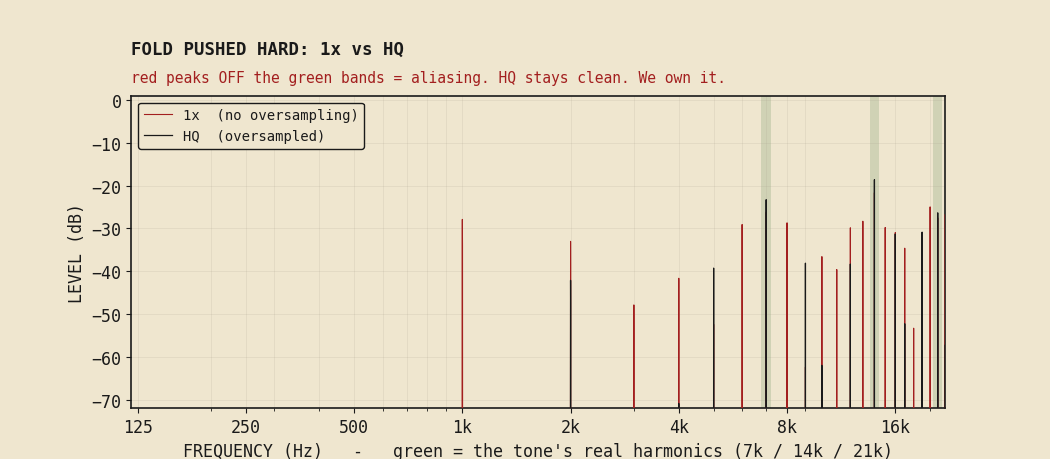
Any nonlinearity also generates harmonics above the audio band. At a standard sample rate those fold back down as inharmonic alias tones — the brittle, "digital" edge cheap distortion has. NOVA oversamples in HQ mode to push them out of the way. Below is FOLD driven hard, at 1× and in HQ: at 1× it aliases, and we're showing it rather than hiding it.
What it costs
In our offline test, here is how many times faster than real time the engine renders on a single core:
| Mode | Throughput |
|---|---|
| 1× (standard) | 17.7× real time |
| HQ (oversampled) | 6.4× real time |
Single-threaded, offline render. The absolute speed scales with your CPU — what's fixed is the relationship: HQ costs about 2.8× standard. Live DAW load also depends on your buffer size and host, so treat this as relative headroom, not an absolute percentage.
From the thread — what the community sharpened
We don't publish these from a tower. This note went up on r/edmproduction, and in a day the room pushed it further than we would have alone. UNDERDUB is a research collective — so here is what producers added, credited to them.
The math, sharpened. u/Biansci caught us being loose with the notation. On a two-tone pair the loud products aren't f1±f2 — those are second-order, and usually quiet unless the nonlinearity is asymmetric. The ones that smear a chord are the odd-order products — 2f1−f2, 2f2−f1 — from the cubic term. That's why even a symmetric, "clean-looking" saturator still muddies a chord. (A lovely aside from the same exchange: the difference tones you hear on loud intervals — Tartini tones — are psychoacoustic, generated by the nonlinearity of your own ear, not actually present in the signal.)
Voicing and tuning move the dissonance. u/Au5music nudged us to try just intonation — so we measured it, with a second lens: sensory roughness (the Plomp–Levelt/Sethares model of how dissonant the saturated spectrum is — a perceptual cousin of the junk fraction above, not the same number). When notes sit closer to the true harmonic series, the products line up with harmonics instead of beating between them, so roughness falls. A major triad in JI shed ~46% of the roughness saturation added (+0.37 → +0.20; the equal-tempered major third sits 14 cents sharp — that's the culprit). A dense m9 was voicing-dependent: standard JI barely moved (+1.29 → +1.19), but the septimal 7th (7/4) dropped it ~50% (+1.29 → +0.64). It's the same reason u/tugs_cub noted power chords — fifths and octaves — distort clean. The catch: you can't always retune a mix or revoice a part you've committed to. Which is exactly where splitting earns its keep.
The split isn't free — and the thread knew it. u/wooq, u/iamnotlefthanded666 and u/JonDum flagged the real cost: zero-latency crossovers smear phase where the bands meet. We buy the cleanliness with a linear-phase, perfect-reconstruction filterbank — fine for production, where latency is free — so the trade becomes a faint pre-ring on sharp transients, not crossover smear. They named the tradeoff before we wrote it down.
Same principle, other doors. Several producers (u/SkulGurl's ring-mod-per-note trick, the Serum-2 per-oscillator warp, Repro-5's per-voice saturation) pointed at the cleanest version of all: saturate each voice before the notes combine, and there's nothing to intermodulate in the first place. Dense band-splitting is just that idea applied to rendered audio — for when you can't go back to the synth. And as u/ruminantrecords put it: aliasing fizzes, IMD smears, and you can't oversample your way out of it. The job was never to eliminate it — only to manage where it lands.
Sources
- Intermodulation distortion — definition (sum/difference tones): Wikipedia
- IMD as the lab measure of nonlinearity: Klippel
- IMD in music / why it muddies a mix: Production Expert
- Distort-before-sum stays consonant: Elliott Sound Products
- Odd-order (cubic) intermod products dominate symmetric nonlinearities: Wikipedia — third-order IMD
- Just intonation vs equal temperament (the 14-cent third): Wikipedia
- Tartini / combination tones are psychoacoustic: Wikipedia
- Community thread (r/edmproduction) — the discussion that sharpened this note: r/edmproduction
Method note: junk fraction = output energy outside ±8 Hz of any played note or its harmonics, Hann-windowed FFT, loudness-matched. Measured on our own engine; figures will be republished with the full dataset.
We turned this measurement into a saturator — NOVA-2000, a dense 48-band engine. Get on the waitlist, or come build the next one with us.