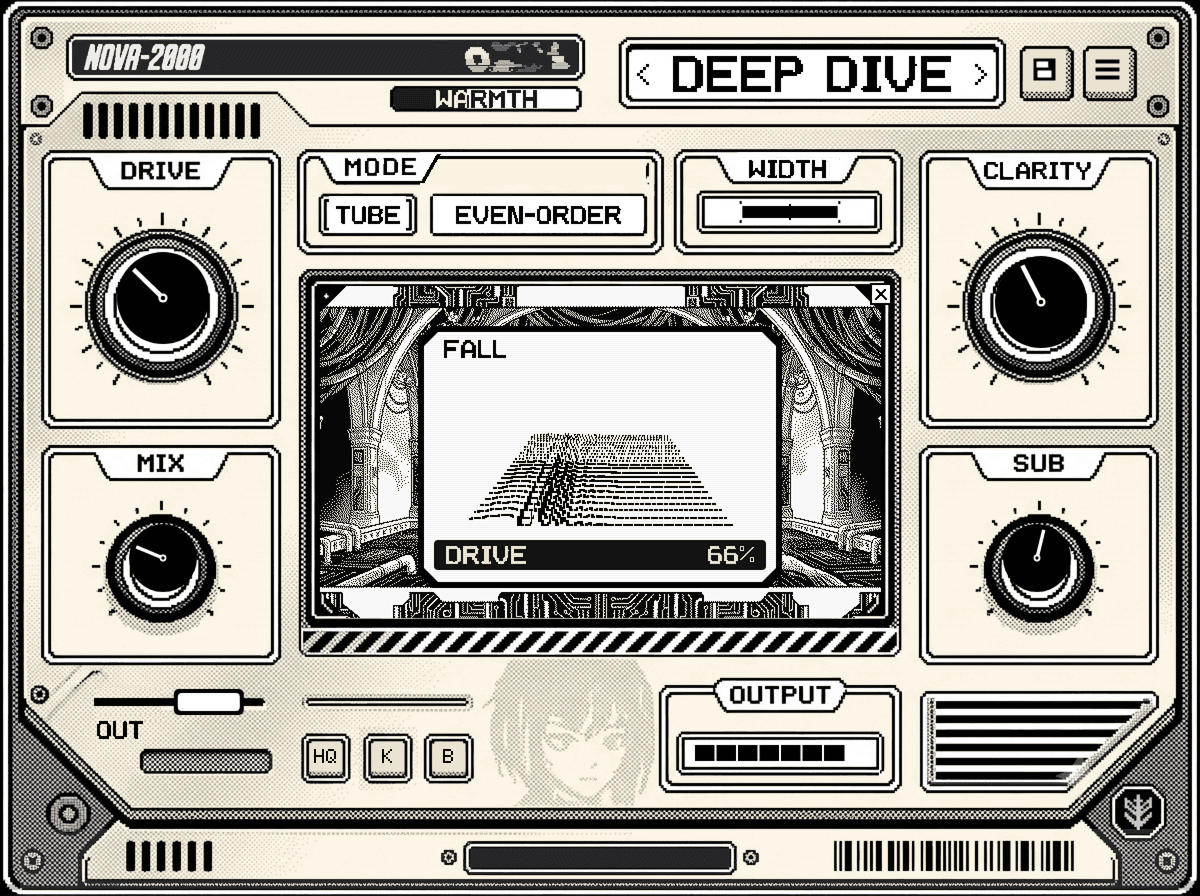
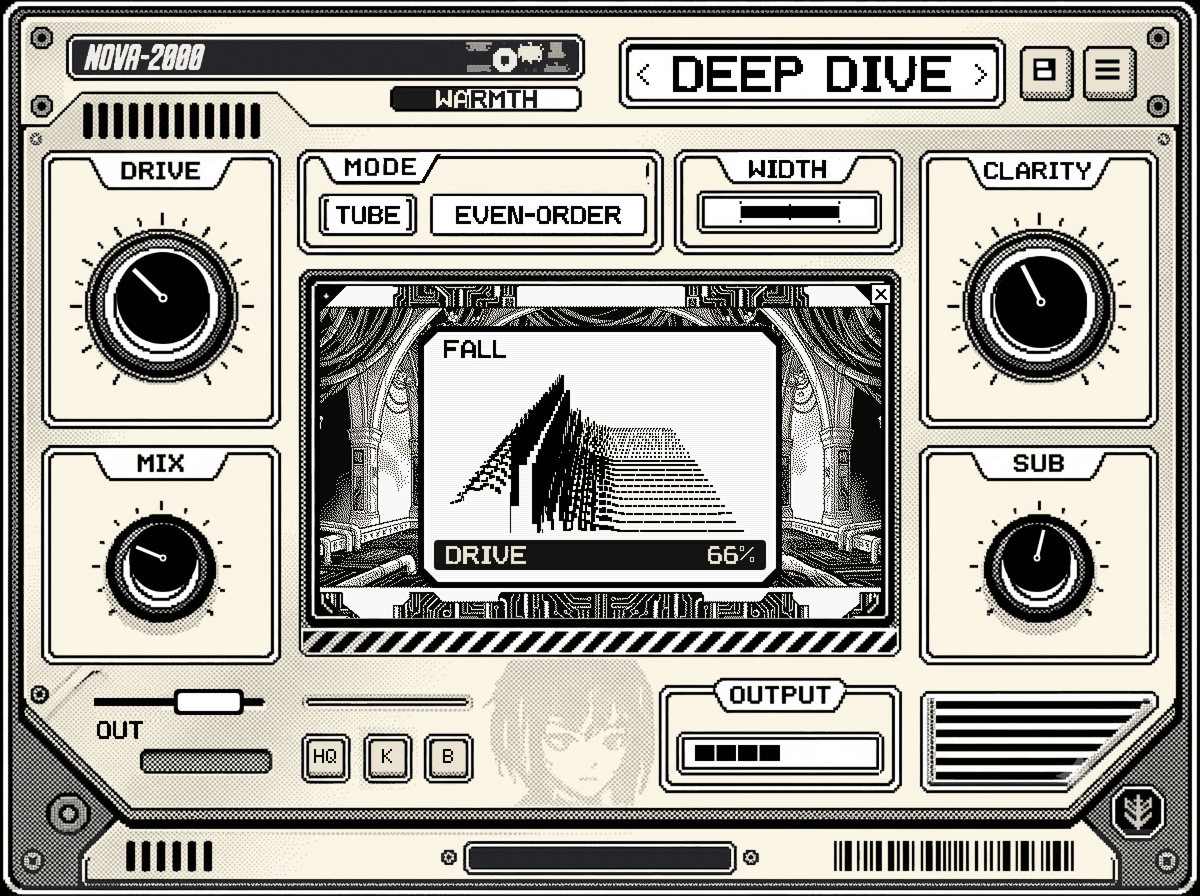
A chord is the worst case for saturation: the notes intermodulate into mud, and a wideband saturator can't dodge it. Same Cm9 stack, same drive, level-matched: an ordinary wideband saturator dumped ~30% of its energy into junk you never played; NOVA at 48 bands, ~1%. Hear it in the locker below.
We measured the band-count curve (Cm9, loudness-matched): 1 band — ~30% junk. 6 bands — ~23% (barely better). 12 — ~18%. 24 — ~5%. 48 — ~1%. The payoff arrives where other multibands stop.
CLARITY: one band to forty-eight, continuous — same CPU, same latency, and the same loudness at every position. AUTO holds your output level, so sweeping CLARITY changes the band count, not the volume. We looked for another saturator with band density on a knob. We did not find one.
DELTA draws the output spectrum minus the input spectrum, per bin. You see what changed. A meter, not a null test — the null test is in the downloads.
832 samples of latency, always — 17.3 ms, host-compensated. That delay IS the precision: 48 linear-phase filters, zero phase smear. It protects your low end, too — SUB keeps everything below 120 Hz phase-coherent; WIDTH moves only the sides. Costs an order of magnitude more CPU than a plain saturator.
AUTO output level-match, always on. Output loudness tracks the input, so DRIVE, CLARITY and the algorithm change the tone — never the volume. Fair A/B while you dial, and it can't clip from a hot boost. The OUTPUT slider rides on top as a +/- dB trim.